The Workspace as an Extension of Executive Function
Your physical surroundings are not a neutral backdrop for your work. They function as an external cognitive exoskeleton that either supports or drains your mental energy. For those in high-stakes leadership roles, the office should be viewed as a functional component of executive function itself. When you align your physical space with your neurological requirements, you reduce the metabolic cost of staying focused throughout the day. This shift in perspective turns your environment from a passive container into an active tool for mental endurance.
Moving Beyond Aesthetics to Functional Utility
Design is frequently mistaken for mere decoration. In a high-utility environment, aesthetics are secondary to how a room supports mental clarity. Every object in your field of vision should contribute to your primary objective. If a piece of furniture looks good but forces you into a posture that causes physical discomfort, it is a liability. True utility ensures that your physiological needs are met so your mind can remain unburdened by bodily stress.
Why Your Desk Setup is a Biological Variable
The relationship between your body and your desk is a matter of physiology. Factors like monitor height, desk surface texture, and ambient temperature directly influence your nervous system. If these variables are not managed, they trigger minor stress responses that accumulate as the hours pass. Optimizing these elements is not about comfort in a superficial sense; it is about maintaining your biological capacity for sustained cognitive labor.
Spatial Anchoring: Using Architecture to Automate Focus
The human brain is highly sensitive to context and physical location. Spatial anchoring is the practice of associating specific areas with specific mental states. By creating a dedicated zone that is used exclusively for high-level work, you train your brain to switch into a focus state the moment you enter that space. This reduces the friction of starting a difficult task because your environment signals that it is time for deep immersion.
The Science of Peripheral Neutrality
Human vision is designed to detect motion and contrast in the periphery as a survival mechanism. In a modern workspace, this means that any visual clutter or movement in your side view is a constant distraction for your amygdala. Peripheral neutrality is the practice of stripping the edges of your vision of all unnecessary data. When your surroundings are stable and quiet, your focus remains centered, making it easier to stay in a state of concentration.
Engineering Sightlines to Minimize Task-Switching Costs
Looking up and seeing a reminder of an unrelated project or a distracting view is enough to pull your mind away from your current objective. This creates a task-switching cost that depletes your cognitive energy. By engineering your sightlines so that you only see what is necessary for the current project, you protect your attention from these invisible drains. A clear visual path allows for a clear mental path.
"Your workspace is the physical manifestation of your priorities. When your space is aligned with your goals, peak performance becomes the path of least resistance."
Prospect and Refuge: Designing for Strategic Thinking
The concept of Prospect and Refuge is an environmental psychology principle that describes the human need to see a broad view while having a protected back. For strategic thinking, this balance is essential. It provides a sense of security that allows the brain to exit a defensive mode and enter an expansive, visionary state.
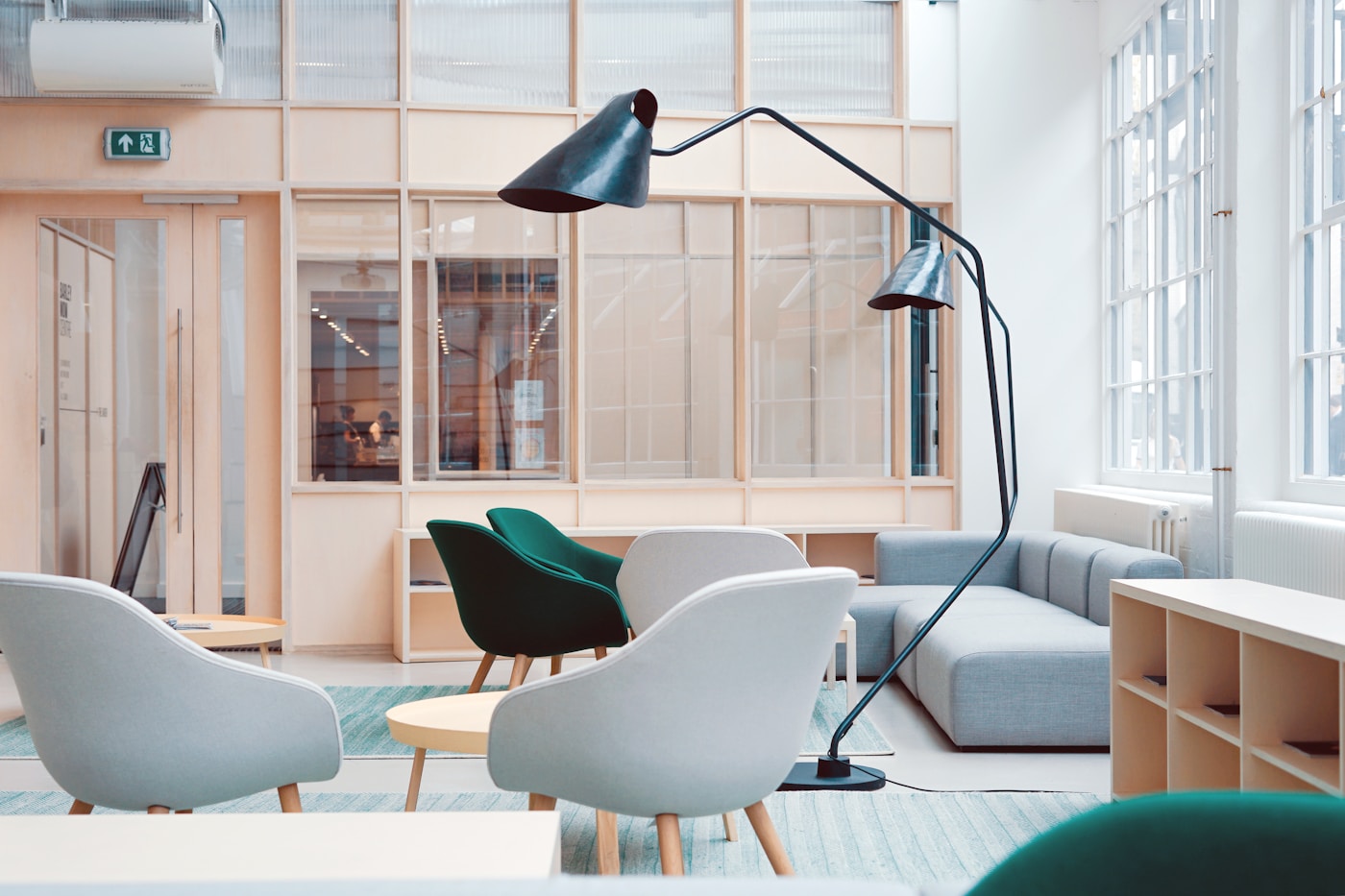
Prospect and Refuge theory in practice: a clear view forward, a protected position behind.
Why High-Stakes Planning Requires Physical Depth
There is a direct correlation between the depth of your physical view and the breadth of your mental perspective. Working in a cramped, windowless room can lead to small, reactive thinking. High-stakes planning requires the spatial permission provided by a long view or a wide horizon. Physical depth encourages the mind to consider long-term outcomes and distant variables, giving your thoughts the room they need to expand.
The Relationship Between Ceiling Height and Abstract Thought
Ceiling height influences how we process information. High ceilings tend to facilitate abstract, relational thinking and creativity. This is known as the Cathedral Effect. When you need to connect disparate ideas or innovate, a space with vertical volume is a strategic necessity. The physical height overhead translates into mental freedom.
Creating Enclosure for Linear Problem Solving
When it is time to shift from strategy to execution, a sense of enclosure becomes more effective. Smaller, more contained spaces help keep the mind from wandering. These areas create a cocoon-like environment where external variables are minimized, allowing for the linear, step-by-step processing required for difficult implementation.
Eliminating Cognitive Micro-Friction
Micro-friction refers to the small, annoying physical obstacles that disrupt your flow. This might be a drawer that sticks, a cord that is too short, or a chair that squeaks. Individually, these are minor annoyances. Cumulatively, they act as a steady leak in your cognitive tank, leading to premature fatigue and irritation.
The Strategic Audit of Physical Objects
A strategic audit involves examining every item in your workspace and questioning its utility. If an object does not assist your focus or contribute to your recovery, it is a liability. Removing these items clears the path for mental clarity. A high-utility environment is defined as much by what is absent as by what is present.
How Tactile Feedback Influences Performance
The feel of the tools you touch daily provides a constant stream of information to your brain. Natural materials like solid wood, stone, or heavy linen offer a grounding tactile experience that synthetic materials cannot replicate. This haptic feedback helps keep you present in your body and focused on the work at hand, reducing the tendency for the mind to drift into distractions.
The Intentional Headquarters: A Final Word on Spatial Sovereignty
Your workspace is the physical manifestation of your priorities. By exercising sovereignty over your environment, you assert control over your focus. This is the essence of architectural living: building a physical headquarters that serves as the foundation for your highest work. When your space is aligned with your goals, peak performance becomes the path of least resistance.